


'/%3E%3Cpath%20fill='%23b2b2b2'%20d='M241%20382q0%2016%2017%2026%2017%2011%2042%2011t42-11q16-11%2017-26V269H241'/%3E%3Cpath%20fill='%239f7e00'%20d='M241%20379q0%2014%208%2023%209%209%2021%209%2014%200%2021-9%209-9%209-23V269h-59'/%3E%3Cpath%20d='M241%20339v-70h59v110q0%2014-9%2023l-6%205v-68h-15v72q-8%200-14-4v-68zm59%2040c0%2022%2015%2032%2029%2032%2021%200%2030-18%2030-32v-40h-59'/%3E%3Cpath%20fill='%239f7e00'%20d='M266%20277v5h2v12h-3v-5h2v-5h-9v5h2v5h-4v9h3v18h-5v10h34v-10h-5v-18h3v-9h-4v-5h2v-5h-9v5h2v5h-3v-12h2v-5zm42%20101q0%2010%206%2017%206%206%2015%207%2010-1%2016-7%206-7%206-17v-29h-43'/%3E%3Ccircle%20fill='%230044ad'%20cx='329.5'%20cy='372'%20r='6'/%3E%3Cellipse%20fill='%230044ad'%20cx='300'%20cy='340'%20rx='16'%20ry='21'/%3E%3C/svg%3E)


When you ask what Vienna is famous for, the answers usually come quickly: imperial palaces, classical music, and grand coffeehouses. While correct, these responses only scratch the surface of a city where history is not something distant — it is part of everyday life.
In this article, we explore the key elements that make Vienna famous, from its imperial past and musical heritage to its coffeehouse culture, architecture, and its strong connection to nature.
Untangling the Threads of Viennese Identity

To truly grasp what makes Vienna Vienna, one must look beyond a simple checklist of sights. The city’s character is a rich tapestry, woven from over 600 years as the heart of the Habsburg Empire, an epicentre of artistic genius, and the cradle of intellectual movements that later spread across the globe. The decisions made within the Hofburg Palace did not merely shape a city; they shaped European history, and the lavish culture of the court set a standard that Vienna still embodies.
You can feel this imperial past everywhere, not just within the walls of Vienna’s countless museums. You can see it in the city’s grand scale and its formal, yet undeniably charming, public life. The Habsburgs’ ambition is everywhere, embedded into the very stones of the palaces and boulevards.
The City as a Stage for Genius
Vienna’s fame is closely tied to its role as a centre of creativity. This is where musical history was shaped by composers such as Haydn, Mozart, Beethoven, and Strauss, whose music still fills concert halls and public spaces across the city.
If you want to experience Vienna’s most authentic concert halls, we recommend checking out our Secret Concert here!
The city’s creative life was not limited to music. Around the turn of the 20th century, Vienna became a centre for new ideas. Its coffeehouses developed into places where thinkers such as Sigmund Freud and writers like Stefan Zweig or Arthur Schnitzler met to discuss and challenge the ideas of their time.

Vienna as the Capital of Music
Therefore, to truly understand Vienna, you must listen. For centuries, music has been more than an art form here; it is the city’s very pulse. This is where the titans of classical music did not just come to work; they came to live, to create, and to alter the course of music history forever.
Consider Ludwig van Beethoven, a true genius from Bonn who chose Vienna as his home. His time here was defined by defiance. Imagine the scene in 1805 at the Theater an der Wien for the premiere of his Third Symphony, the ‘Eroica.’ Originally dedicated to Napoleon, Beethoven furiously scratched out the dedication upon hearing Bonaparte had declared himself emperor. The symphony’s raw, emotional power confused many, but it heralded a bold new sound for a new century.
And then there is Wolfgang Amadeus Mozart. His career in Vienna was a whirlwind of breathtaking creativity. When his opera The Marriage of Figaro premiered at the old Burgtheater in 1786, it was far more than a comedy. It was a sharp, witty critique of the aristocracy—a risky subversion for the time, yet its genius was undeniable.
For anyone who wishes to follow in their footsteps, you can book our Musical Tour to uncover their secrets.
The Waltz Kings and a Dancing Empire
No discussion of Viennese music is complete without the Strauss family. Johann Strauss I and his son, Johann Strauss II, elevated the waltz from a simple country folk dance into the glamorous soundtrack of the 19th-century empire. The waltz became the very rhythm of Vienna.
When Johann Strauss II debuted “The Blue Danube” in 1867, the initial reaction was surprisingly unremarkable. It did not take long, however, for the piece to become Vienna’s unofficial anthem, its melody now inseparable from the city’s romantic image. The music of the Strauss dynasty was democratic, echoing from grand ballrooms to public parks and cafés.
Guardians of a Priceless Legacy
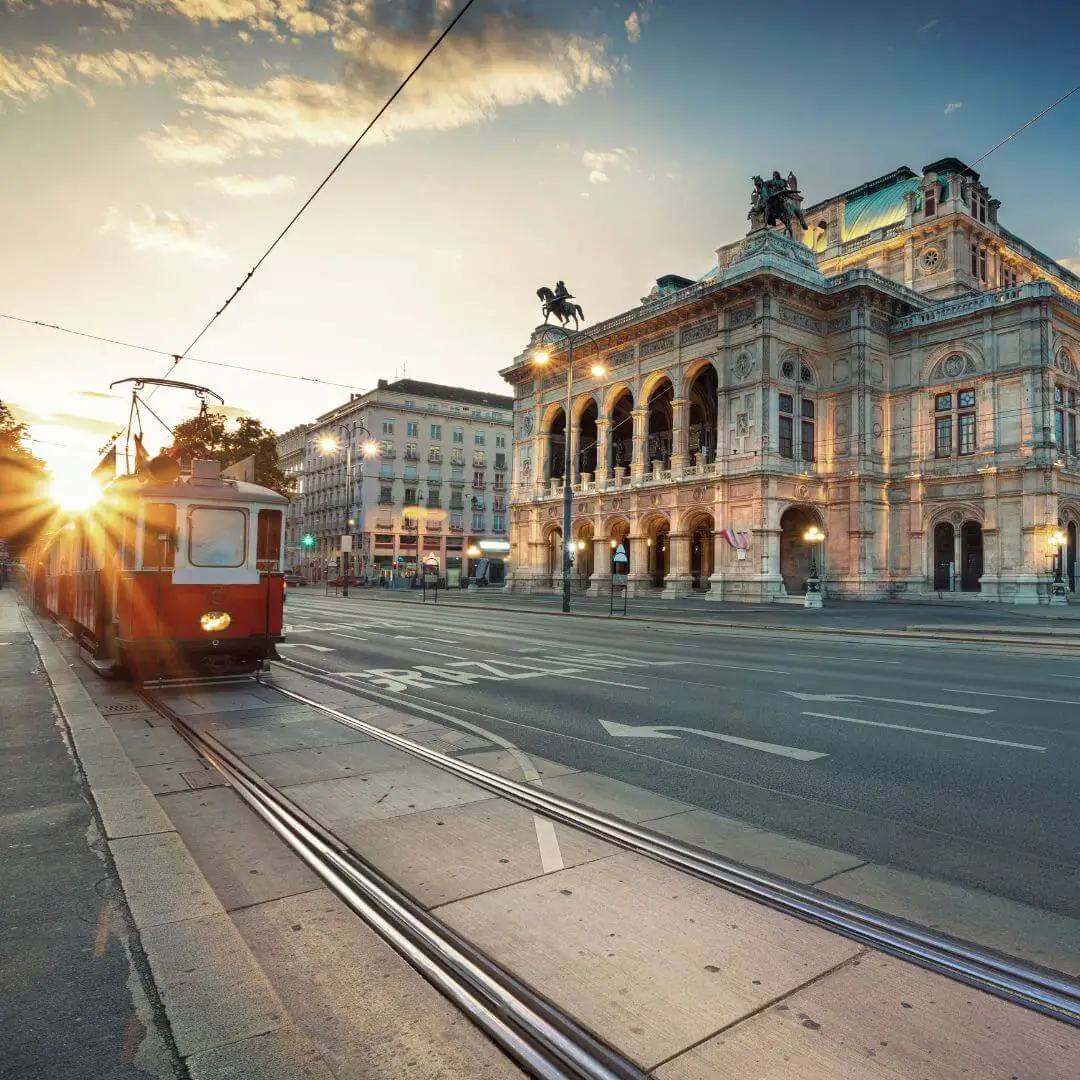
Vienna’s musical heritage is fiercely preserved by world-class institutions. The Vienna State Opera (Wiener Staatsoper), the first building on the Ringstrasse, is a temple to the art form and a place where legendary performances regularly take place. We highly recommend including a visit in your itinerary and you can find some more information about their tours here. You can read more about how the city cemented its reputation in our article exploring why Vienna is called the capital of classical music.
With over 300 monuments dedicated to composers—more than any other city on earth—it is no wonder Vienna is called the ‘World Capital of Music.’ This identity is upheld by ensembles like the Vienna Philharmonic, founded in 1842. Their annual New Year’s Concert, a tradition since 1939, is broadcast to over 50 million people worldwide, sharing a piece of Vienna’s soul with the globe.
Discovering The Viennese Coffeehouse Culture

To truly understand Vienna, one must understand its coffeehouses. These are far more than just places to get coffee. We are talking about truly revered institutions, the city’s public living rooms. If you are looking for a place for quiet thought or a stage for lively debate (at least in the 19th century), Vienna’s cafes were your absolute haven. This tradition is so vital that UNESCO declared it an Intangible Cultural Heritage in 2011.
Like many Viennese legends, the story begins with a siege. After the Ottoman army was repelled from the city walls in 1683, they allegedly left behind sacks of mysterious dark beans. An Armenian spy named Johannes Diodato, who knew of coffee from his time in the Ottoman Empire, recognised their value and was granted a license to serve the beverage. From these almost mythical origins, the Viennese coffeehouse was born.
These and many similar stories can also be heard on our “Vienna’s culinary history audio tour“, just a small tip for you to consider. For 9.99 euros, you can walk through 30 culinary stations and dive deeper into the fascinating world of Viennese cuisine.
The City’s Intellectual Heartbeat
By the turn of the 20th century, the Kaffeehaus was the epicentre of Viennese intellectual life. These grand cafés became the unofficial offices and social clubs for the city’s most creative and political minds. Writers like Stefan Zweig and Peter Altenberg practically lived in them, drawing inspiration from the daily theatre of life unfolding around them.
One could find artists like Gustav Klimt and Egon Schiele sketching revolutionary ideas on napkins, while thinkers such as Sigmund Freud and Leon Trotsky held court, dissecting society over a Melange. The coffeehouse was a uniquely democratic space where a penniless poet could sit a table away from a wealthy industrialist, both equals in their shared need for caffeine and conversation.
This is a place where you can be alone without feeling lonely—a quiet refuge from the bustling city. The atmosphere is carefully preserved: classic Thonet bentwood chairs, cool marble-topped tables for spreading out a newspaper, and tuxedo-clad waiters (Herr Ober) who move with elegance and grace.
Navigating the extensive coffee menu can be a skill in itself. To order like a Viennese local, you may find our guide on how to properly order coffee in Vienna useful.
A Delicious Tradition – Vienna’s desserts
Have you heard of the Viennese Apfelstrudel or the Cremeschnitte? We are quite sure you have! And that’s another thing Vienna is famous for worldwide – its pastries. After all – a coffee is rarely ordered alone, it is almost always paired with a slice of cake, transforming a simple break into a cherished ritual. The glass display cases of Vienna’s traditional cafes are filled with temptations, each with its own story.
The Sacher-Torte is perhaps the most famous—a dense chocolate cake with a thin layer of apricot jam. The recipe was invented in 1832 by a 16-year-old apprentice, Franz Sacher, when he was unexpectedly tasked with creating a new dessert for Prince Metternich.
Another beloved staple is the Apfelstrudel, a delicate pastry filled with spiced apples, raisins, and breadcrumbs. Its origins trace back to the Ottoman Empire, arriving in Vienna via Hungary, where it was perfected into the comforting dessert we know today.
We love Apfelstrudel so much that we offer two daily baking workshops for people who want to learn how to make the perfect Apfelstrudel. The daytime Apfelstrudel workshop and the Apfelstrudel and Pretzel evening workshop take place in a beautiful baking studio near Schönbrunn palace and will surely transform your visit!

Vienna’s Architectural Grandeur and Artistic Rebellion
You cannot speak of Vienna without discussing its architecture. The city itself feels like an open-air museum, with centuries of imperial ambition and artistic genius carved into its stone. The best place to begin is the Ringstrasse, the spectacular boulevard that replaced the old city walls in the 19th century. This was not just a construction project; it was an empire making its grandest statement.
The undertaking was the vision of Emperor Franz Joseph I. After ordering the city’s ancient fortifications demolished in 1857, he envisioned a circular showcase of architectural splendour that would proclaim the Habsburg Empire’s cultural sophistication and power. The result was a theatrical parade of historical styles known as Ringstrassenstil.
A Vision in Stone: The Ringstrasse
Walking the Ringstrasse is like walking through the Emperor’s ambition. Each monumental building was deliberately designed in a particular historical style, meant to tell a story about a specific civic or imperial ideal. This was architecture as propaganda.
The Parliament, for instance, was built in a Greek Revival style as a direct nod to Athens, the birthplace of democracy. The enormous Rathaus (City Hall), by contrast, soars in a Neo-Gothic style, a proud assertion of the independence of Vienna’s citizens, echoing the free cities of Flanders.
Nothing about this eclecticism was accidental. It was a carefully curated lesson in history and power. It captures the confident, almost swaggering spirit of late 19th-century Vienna. Interestingly enough, it was also a sign that the empire was approaching its end.
A Rebellion in Art: The Vienna Secession
Just as the Ringstrasse’s grand historicism came to define the establishment, a group of radical young artists decided it was time to break the rules. In 1897, led by Gustav Klimt, they broke away from the conservative artists’ association to form the Vienna Secession.
Their motto declared their mission: “To every age its art, to every art its freedom.” They rejected stiff academic traditions and set out to create a completely new, modern style. Their iconic exhibition hall, with its golden laurel-leaf dome—fondly nicknamed the “golden cabbage”—stands as a monument to their rebellion. The Secession did not just change painting; it influenced architecture, graphic design, and furniture, helping to forge Viennese Modernism and alter the course of art forever.
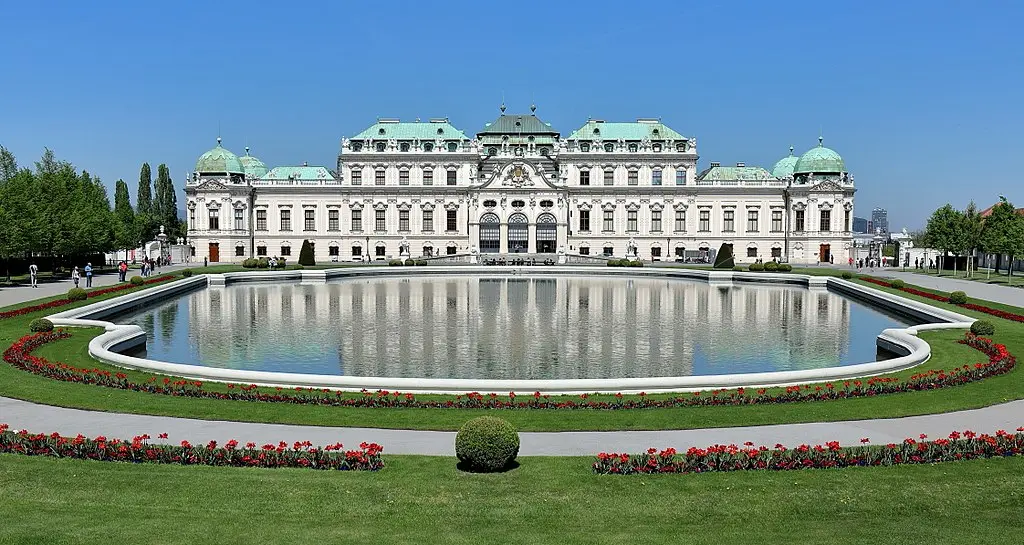
The paintings of Gustav Klimt, including “The Kiss” or “The Lady in Gold” are world renowned. The latter is in New York but the former is one of the reasons tourists fly from far away to visit Vienna. You can also see this magnificent painting on our Belvedere Museum Tour.
Beyond the Palaces: Life in Vienna’s Parks and Waterways
While Vienna’s imperial heart commands much of the attention, the city’s true soul is often found in its green spaces and along its waterways. This is the Vienna of the Viennese—a city that breathes through its expansive parks, a world away from the grandeur of the city centre.
To experience this side of Vienna, one must start with the Vienna Woods (Wienerwald). This vast expanse of forested hills encircles the city’s western edge, serving as its essential ‘green lung.’ It is more than a forest; it is a protected biosphere reserve and an integral part of local life. For centuries, these woods were the private hunting grounds of the Habsburgs; today, they are a beloved escape for everyone.
We love this part of Vienna so much that we offer various experiences there, including a fun E-bike tour and an archery experience. These are available both for private groups or as public activities.
Heurige: The Vienna Woods’ Authentic Wine Taverns
Hidden within the Vienna Woods are the city’s famed Heurige, rustic wine taverns that are a cornerstone of Viennese culture. These are not fancy restaurants but simple, family-run establishments where local winemakers serve their newest wine of the season—a tradition dating back to an 18th-century decree by Emperor Joseph II.
A visit to a Heuriger is a fundamental Viennese experience. You will find yourself at a long wooden table in a leafy courtyard, selecting simple but delicious local food from a buffet and sipping young, fresh wine. It is a relaxed and deeply communal ritual—a perfect embodiment of the Viennese concept of Gemütlichkeit, that untranslatable feeling of cosy contentment.
The Three Faces of the Danube
Many visitors arrive in Vienna seeking the “Blue Danube” of the famous waltz. They expect the river to flow through the city centre. The reality is more complex. Vienna’s relationship with its river is defined by three separate waterways, each with its own purpose and character.
- The Danube River (Donau): This is the main, powerful river. Following catastrophic floods in the 19th century, it was heavily regulated. It now flows just outside the city centre, primarily serving as a major shipping channel.
- The Danube Canal (Donaukanal): This arm of the Danube runs along the edge of the historic first district. It is the city’s lively, urban riverfront, lined with graffiti art, bustling bars, and “beach clubs” in the summer. This is where Vienna’s modern, youthful energy thrives.
- The Old Danube (Alte Donau): This is the true treasure. Once a branch of the main river, the Alte Donau is now a massive, calm lake. This is where Viennese families come to swim, sail, and rent paddle boats. It’s a great place to enjoy a peaceful natural oasis within the city.
We highly recommend visiting the Old Danube, especially during the spring and summer. If you do, make sure to join us as we explore it on one of our canoe tours.
How To Experience The Authentic Soul Of Vienna
To truly get under Vienna’s skin, one must look beyond the grand palaces and perfect façades. The city rewards the curious, inviting you to step into its history as an active participant.
By all means, admire the imperial architecture, but also seek out the city’s hidden parts. These include the medieval courtyards or traces of its Roman origins. These quiet corners hold the tales of old Vienna, long before the construction of its famous boulevards.
Our daily walking tours are a great opportunity to do just that. You can join our “Vienna’s Origins tour” or our “Highlights tour“. Another option is our “Secrets of the old town tour” for a complete experience of the old town.
Vienna’s Enduring Allure in 2026
As you see, Vienna is famous for many reasons and even today, its past attracts millions of visitors. In 2025, Vienna’s appeal soared, reaching a record-breaking 20,065,000 overnight stays—a 6% increase from the previous year. This is a global fascination, with international visitors accounting for a remarkable 83% of those stays. You can read more about Vienna’s record-breaking tourism success if the figures intrigue you.
We hope to welcome you soon to our city! We’ll gladly show you its beauty on one of our Secret Vienna Tours!